Seoul, South Korea

Updated: Oct 20, 2024
I did not expect to love South Korea.
I expected to love Singapore. A friend sent me pictures from studying there, green hills rolling up and into academic buildings. The city is sprinkled with incredible architectures marvels. Flowers drip from its tall towers. And the food, I could go on and on about the food. But I didn’t fall in love with Singapore.
Not like South Korea.

I’m going to have to learn more than just thank you 감사합니다 (gamsahamnida), though English took me further than I was expecting. The common theme you’ll find in my love of cities is a mix of nature, architecture, and culture. The pervasiveness of nature in Seoul seems less like an architectural decision and more like a losing battle against the Namsan and Bukaksan mountains. Whereas the greater Tokyo area exists in plains between mountains, which somewhat explains it’s very sprawling shape, Seoul chose the protection of mountains from its neighbors with the valleys and farms just outside of it. This means that every time you want a cup of coffee, even if your phone says “Oh, it’s only one hundred meters from here!” it will inevitably be up hill, both ways. At least the views from every place you go will be breathtaking… literally and figuratively.

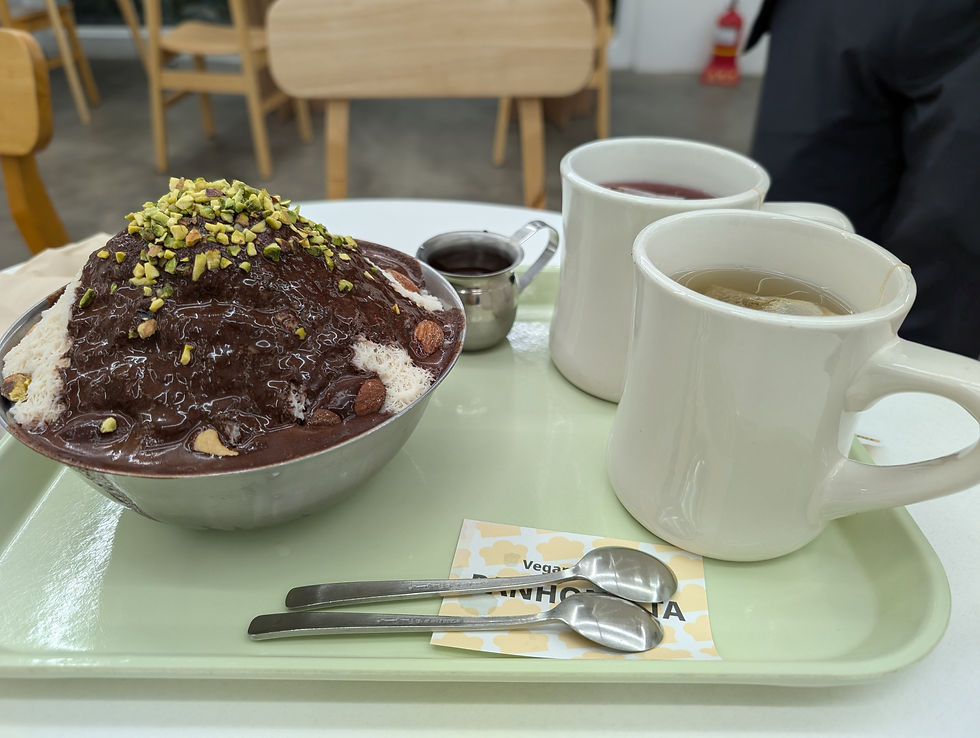
Speaking of coffee, there are over 18,000 cafes in Seoul (World Coffee Portal) and over 80,000 cafes in all of South Korea (The Korea Herald). That’s almost one café per 500 residents in the city alone. As someone who loves exploring cafes, taking a slow morning to read in one or have a cup of coffee with a friend, the coffee culture appealed greatly to me. I visited a coffee shop with a cute white Shepherd dog who reminded me of Charge, a small coffee stall on a busy street, a fancy café that boasted fake rain storms every so often and rain themed drinks, and even a 24-hour joint with couches and study space for university students. If I could stay longer, I think I would have tried to visit a unique one every day… and I still wouldn’t make a dent.

Interestingly, I should mention there are two types of Starbucks in South Korea – the regular kind and Starbucks Reserves which additionally serve as roasteries. I typically endeavor to avoid chains when able, but I also like the localized mugs they offer and the fact that they have decaf (which is relatively uncommon in Asia), so I inevitably poke my head into one. The one I visited in South Korea was Starbucks Seoul Wave Art Center, located in a floating building on the Han River. The seating is quite limited, but if you can grab a seat, the view is worth it.
We weren’t in South Korea for very long, but the trip was packed. We did a great deal of hiking and visiting parks. While we ate an incredible amount of good food, we ended up eating a surprising amount of western fare. Korean food, like Japanese food, isn’t supposed to contain a lot of dairy. And like Japanese food, that is a lie. Almost every single bag of chips in the convenience stores (dubbed “CVS” like the drug store, unlike Japan’s cute “konbini”) contains milk product. David and I suspect it is an absolutely abhorrent love of cheese powder, but as neither of us are fluent in Korean, I couldn’t really tell you.
We started out our trip hiking the Seoul City Wall which encompasses much of the city. It was built in the Joseon Dynasty in the 14th century, an additional protection to the mountains to dissuade invaders and mark the boundaries of the city. It currently spans almost 20 kilometers with gates and towers that are historical landmarks you can visit today. No, we didn’t do all 20 kilometers at once, though if we included elevation gain and loss we really might have. We did sections of it throughout our stay. At one point, we wandered into the heart of Seoul afterwards, and happened upon the Seoul Library having set up rows of bookshelves along a park and vendor area in the middle of the city. There were cute bean bag chairs, silly chairs, little tents, and food stalls. It didn’t end there. The river running through the city was also lined with benches, an even quieter and cozier place to sit down and read. It’s really too bad I’m illiterate. These little pieces of day-to-day life here made the place absolutely remarkable.

We made our way out to Suwon and to a Korean Folk Village. It reminded me vaguely of Historic St. Mary’s City in my hometown, a slice of history preserved and managed for school trips and a nice stroll through time, for those curious enough. It’s an “open air museum” that preserves traditional Korean homes, clothing, culture, and food. There were several different styles of home from the late Joseon period, from a peasant’s hut to a small, Buddhist school. It was incredibly interesting to read about the different homes and the Korea’s traditional culture before rapid westernization. While I was waiting by my lonesome outside the restrooms, a pale and deformed Korean ghost climbed over my resting tree stump and scared the life out of me. I assume she and her acquaintance from earlier, when David, Naomi, and I had stumbled into the section labeled “Ghost Village” accidentally and offered David up as sacrifice, were unhappy that David did not comply. In quite a turn of events, the village was actively being haunted by gwisin (or dokkaebi, I’m not entirely versed on Korean demons and ghosts). It may have been for Halloween or some event, but it was nevertheless jarring to wander through the historical Korean countryside into screams, claws, and demon eyes. I wonder if the MBC studio set* Korean Village is that entertaining. I’ll have to go back and find out sometime.
On the topic of going back, I would love to return to Bukhansan National Park someday. The trail to its tallest peak was closed by a rockslide. South Korea has 23 national parks, some are mountainous while others serve to protect historical sites. Bukhansan National Park covers the Bukhansan Mountains, which cut into Seoul from the north. It is the easiest national park to reach from the city, especially since it is technically within city limits. While we were thwarted in summiting a mountain, we did stumble upon the largest sitting Buddha in Asia. He was tucked peacefully in the mountain side, much more reclusive than his Kamakura counterpart. Just outside of the park there are many traditional Japanese coffee shops that look out unto the mountains.
We filled out days with street food from Myongdong, visits to jade and turquois palaces, and interesting local festivals. We discovered BHC, perhaps the original version of the American-Korean fried chicken fast food chain Bonchon. We went to an amazing performance that reminded me of a mix of the musical show Stomp and Top Chef. The best moments were still the breaks between moments, sitting on park benches, lazing about in the afternoon sun. It was just a nice city to exist in. To breath for a moment, get a cup of coffee, and look out on endless sky scrapers mixed with green peaks.
So much coffee.
So many stairs.
Seoul.
9/10 – All Korean maps should be topographical. At some point, the number of stairs is just ridiculous.
Additional Fun Fact: Hangul, the Korean Alphabet, literally translates to "Korean letters" (han-geul). There are 14 consonants and 10 vowels. All characters are made of combinations of these letters, and any character can be created using only five strokes (compared to the 10+ for Chinese or Japanese), making it one of the simplest alphabets. The alphabet was created in the 15th century to be efficient and simple, and it was so successful that it greatly increased literacy and the preservation of the Korean language to this day. It even has its own holiday, Hangul Day, on October 9th.
Notes: American, South Korean, and Japanese Starbucks are owned by different corporations.
There is a Korean village or park that was previously an MBC K-Drama television set. It’s now known as Yongin Daejanggeum Park.
References:
"History and Significance of Hangeul." 90 Day Korean, 90daykorean.com/how-to-learn-the-korean-alphabet/#history-and-significance-of-hangeul. Accessed 14 Oct. 2024.
"How the Coffee Shop Became King in South Korea." World Coffee Portal, www.worldcoffeeportal.com/News/2019/How-the-coffee-shop-became-king-in-South-Korea. Accessed 14 Oct. 2024.
"Korea's cafe count surpasses 100,000" The Korea Herald, 20 Sept. 2023, www.koreaherald.com/view.php?ud=20240630050107. Accessed 14 Oct. 2024.


Comments